
Best for avoiding procedural downtime: BPH medication. Best procedural option for a quick return to routine: UroLift, when your prostate anatomy is suitable. Best for a water-vapour approach: Rezum. This 2026 BPH treatment recovery time comparison separates time away from normal activities from catheter use, urinary discomfort and time to symptom improvement.
- BPH treatment recovery time comparison: medication avoids procedural recovery, but side effects and ongoing treatment still matter.
- UroLift suits selected men prioritising a short recovery; prostate anatomy determines eligibility.
- Rezum symptom improvement takes longer than the initial recovery because treated prostate tissue must shrink.
- AIME provides BPH assessment and treatment in Edmonton; choose treatment after diagnosis, not from recovery rankings alone.
Why this matters
The fastest recovery is not automatically the right treatment for benign prostatic hyperplasia, or BPH. Prostate size, the position of obstructing tissue, bladder function and previous urinary retention all affect your options. A short recovery loses its value if the treatment does not adequately address your obstruction.
AIME is a men's sexual health clinic in Edmonton for adult men seeking assessment and treatment of BPH. Start with a clinical assessment through AIME rather than choosing a procedure solely because it sounds less disruptive.
In 2026, compare recovery using separate questions: when can you resume your routine, when can the catheter come out, and when should urinary symptoms improve? Those milestones do not necessarily occur together. Returning to desk work does not mean you are ready for heavy lifting, cycling or sexual activity.
What makes the best BPH treatment for recovery?
Use these criteria before reading the ranking:
- Activity restrictions: Separate light daily activity from strenuous exercise and physically demanding work.
- Catheter burden: Ask whether a catheter is expected, how removal is decided and what happens if you cannot urinate afterwards.
- Urinary discomfort: Burning, urgency, bleeding and temporary worsening of symptoms can continue after you resume normal activities.
- Time to benefit: Treatments that relax muscle work differently from treatments that shrink or remove prostate tissue.
- Anatomical suitability: Prostate size and configuration determine which procedures are appropriate.
- Treatment trade-offs: Consider medication side effects, ejaculation changes, repeat treatment and the risks of surgery alongside downtime.
For a broader procedure comparison, read minimally invasive BPH treatments compared. Recovery is one part of that decision, not a substitute for it.
BPH recovery times at a glance
This 2026 ranking moves from no procedural recovery toward more extensive surgery. It is a practical ordering, not a guarantee that every patient recovers faster from each option than from the next.
| Rank and treatment | Best for | Recovery pattern | Standout feature | Key limitation |
|---|---|---|---|---|
| 1. BPH medication | Avoiding a procedure | No surgical wound or routine postoperative recovery | Treats symptoms without an operation | Side effects and ongoing treatment |
| 2. UroLift | Short procedural recovery in suitable anatomy | Light activity returns before all urinary irritation settles | Retracts obstructing tissue without removing it | Anatomical restrictions and possible retreatment |
| 3. Rezum | Water-vapour treatment | Initial recovery precedes gradual symptom improvement | Treats obstructing tissue using water vapour | Temporary catheter use and irritation |
| 4. HoLEP | Tissue removal across a broad range of prostate sizes | Catheter care and activity restrictions follow surgery | Removes obstructing prostate tissue | Ejaculation changes and temporary leakage |
| 5. TURP | Established surgical relief of obstruction | NHS guidance describes full recovery over 3–6 weeks | Removes tissue through the urethra | Bleeding, recovery restrictions and ejaculation changes |
| 6. Simple prostatectomy | Selected very large prostates | Recovery follows a more extensive operation | Removes the enlarged inner prostate tissue | Greater surgical burden |
1. BPH medication: best for avoiding procedural recovery
BPH medication is the starting point when your priority is avoiding an operation and your clinical assessment supports medical management. Alpha blockers relax muscle around the prostate and bladder outlet. Other medicines, including 5-alpha-reductase inhibitors, act differently and are used in selected patients with prostate enlargement.
Medication has no postoperative recovery period. That does not mean every medicine works immediately, suits every patient or leaves your routine unaffected. Dizziness, blood-pressure effects and sexual side effects need discussion before treatment starts.
BPH medication pros:
- Avoids an incision, endoscopic surgery and postoperative wound healing.
- Does not ordinarily require a catheter simply to start treatment.
- Allows treatment adjustment without committing to a procedure.
BPH medication cons:
- Requires ongoing use when continued benefit depends on taking it.
- Causes side effects in some patients.
- Does not resolve every degree or cause of urinary obstruction.
Best for: Men whose symptoms and assessment support medical treatment, particularly when procedural downtime is a major concern.
Verdict: Hold off on a procedure when medication provides adequate relief and your clinician confirms that waiting is safe. Urinary retention, recurrent complications or inadequate symptom control change that decision.
2. UroLift: best for short procedural recovery in suitable anatomy
UroLift uses implants to hold obstructing prostate tissue away from the urethra. It does not remove that tissue or rely on thermal injury to shrink it. That distinction makes UroLift relevant when your priorities include limited procedural disruption and preservation of ejaculation.
Do not equate a short recovery with an irritation-free recovery. Burning, urgency, pelvic discomfort and blood in the urine can occur after treatment. Some patients need a catheter, and suitability depends on the prostate anatomy and the clinician's assessment.
UroLift pros:
- Opens the urinary channel without cutting away prostate tissue.
- Offers a relatively short recovery for appropriately selected patients.
- Preserves ejaculation more often than tissue-removing operations.
UroLift cons:
- Does not suit every prostate size or configuration.
- Leaves implants in place.
- Further treatment is necessary if relief is inadequate or symptoms recur.
Best for: Men with suitable anatomy who prioritise a shorter procedural recovery and ejaculation preservation.
Verdict: Hold until anatomical suitability is confirmed. UroLift belongs near the top of a recovery-focused shortlist, not automatically at the top of every BPH treatment plan.
3. Rezum: best for a water-vapour approach
Rezum delivers water vapour into selected areas of enlarged prostate tissue. The treated tissue changes and shrinks over time, reducing obstruction. AIME offers Rezum water vapour therapy as part of its BPH treatment services.
The recovery distinction is straightforward: being back to light activity is not the same as having the full urinary benefit. Swelling and irritation can temporarily worsen symptoms, and catheter use is part of recovery planning. Arrange practical support around catheter management rather than assuming a minimally invasive procedure means no aftercare.
Rezum pros:
- Treats obstructing tissue without conventional tissue-removing surgery.
- Provides an option for selected men seeking to preserve ejaculation.
- Uses a different approach from long-term medication.
Rezum cons:
- Symptom improvement is gradual rather than immediate.
- Temporary urinary irritation and catheter use require planning.
- Prostate anatomy and bladder function affect suitability and outcomes.
Best for: Men suitable for water-vapour treatment who accept a staged recovery and delayed symptom improvement.
Verdict: Hold until you understand the catheter plan and the expected symptom timeline. Rezum is not the best fit when your overriding expectation is immediate, complete relief.
4. HoLEP: best for tissue removal across prostate sizes
Holmium laser enucleation of the prostate, or HoLEP, separates obstructing prostate tissue from the surrounding capsule and removes it through the urethra. It treats the obstruction by removing tissue rather than retracting it or waiting for it to shrink.
HoLEP involves anaesthesia, postoperative catheter care and restrictions during healing. Temporary urinary leakage can occur, and ejaculation commonly changes after surgery. Recovery advice must reflect your operation, bleeding and bladder function, not simply the word laser.
HoLEP pros:
- Removes obstructing tissue rather than leaving the obstruction in place.
- Treats a broad range of prostate sizes in appropriately selected patients.
- Provides tissue for laboratory examination.
HoLEP cons:
- Requires surgical recovery despite having no external incision.
- Commonly changes ejaculation.
- Temporary leakage and urinary irritation can complicate the return to routine.
Best for: Men who need substantial tissue removal and accept surgical recovery to address the obstruction.
Verdict: Hold only long enough to establish whether tissue-removing surgery is indicated. Do not reject HoLEP solely because a less invasive procedure has a shorter initial recovery.
5. TURP: best for an established tissue-removing operation
Transurethral resection of the prostate, or TURP, removes obstructing prostate tissue through an instrument passed along the urethra. It does not require an external incision, but the internal surgical area still needs to heal.
NHS patient guidance for TURP describes a hospital stay of 1–3 days, a return to work commonly after 3–4 weeks, and full recovery over 3–6 weeks. These are general planning intervals, not an individual discharge or clearance schedule. Physical work, bleeding and complications change the advice you receive.
TURP pros:
- Directly removes tissue responsible for obstruction.
- Is an established surgical treatment with clear postoperative care requirements.
- Provides tissue for laboratory examination.
TURP cons:
- Requires more recovery planning than a non-surgical treatment.
- Carries bleeding and other surgical risks.
- Commonly changes ejaculation, including retrograde ejaculation.
Best for: Men whose clinical findings support TURP and who can accommodate its recovery restrictions.
Verdict: Hold off on heavy activity until your surgical team clears it. Feeling better does not establish that the internal surgical area has finished healing.
6. Simple prostatectomy: best for selected very large prostates
Simple prostatectomy removes the enlarged inner portion of the prostate. It is different from radical prostatectomy, which removes the prostate for cancer treatment. Open, laparoscopic and robotic approaches have different recovery requirements.
This option sits last in a recovery-focused ranking because it involves a more extensive operation. That position is not a judgment against its clinical value. For selected very large prostates, the relevant comparison is with other appropriate tissue-removing treatments, not with procedures for which the patient is unsuitable.
Simple prostatectomy pros:
- Addresses substantial enlargement in selected patients.
- Removes obstructing tissue.
- Provides an option when prostate size changes the surgical decision.
Simple prostatectomy cons:
- Requires more extensive postoperative planning.
- Involves catheter management and surgical risks.
- Recovery differs by operative approach and individual health.
Best for: Men with very large prostates whose specialist recommends this operation.
Verdict: Skip simple prostatectomy as a shortcut to minimal downtime. Consider it when the anatomy and treatment goals justify the surgical burden.
Plan recovery around separate milestones
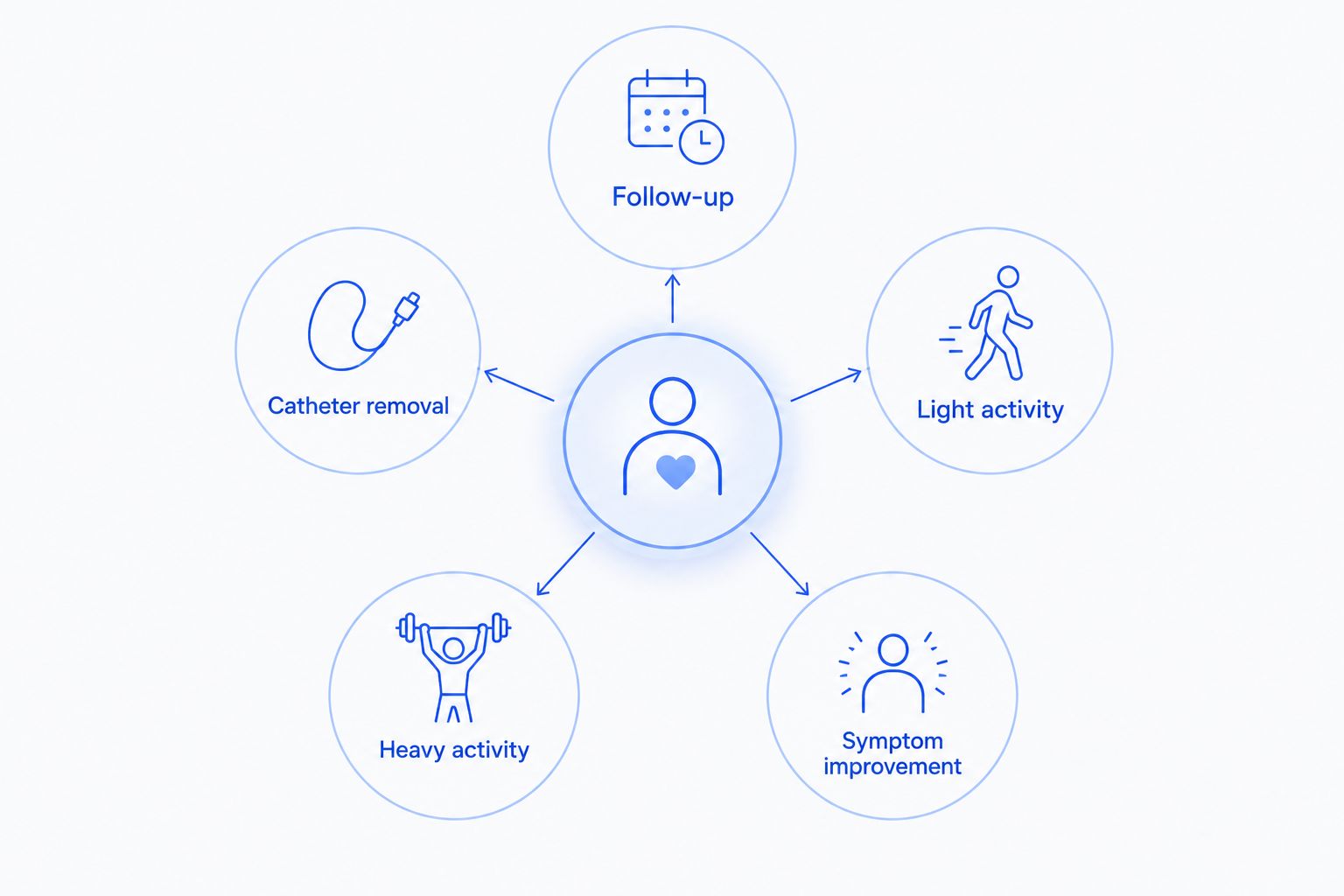
Before choosing BPH treatment, ask your clinician to distinguish these milestones:
- Catheter removal: What determines removal, and who helps if you cannot pass urine afterwards?
- Light activity: Which daily tasks are permitted while discomfort or bleeding continues?
- Heavy activity: When can you resume lifting, strenuous exercise and physically demanding work?
- Symptom improvement: When should the treatment begin helping, and when is the result assessed?
- Follow-up: Which symptoms require a call, and when is your next review?
A desk-based job and a lifting-based job require different plans. Describe your actual work rather than asking only when you can return to work. Include your commute, access to a toilet and any tasks that place pressure on the pelvic area.
Recovery instructions also need an escalation plan. Inability to urinate, fever or chills, worsening severe pain, or heavy bleeding with clots requires urgent medical assessment. Do not wait for a routine follow-up appointment when those symptoms occur.
How the treatments were ranked
This 2026 ranking prioritises procedural disruption, catheter burden and activity restrictions before speed of symptom improvement. Medication comes first because it avoids an operation. UroLift and Rezum precede tissue-removing surgery because their treatment approaches generally impose less initial procedural disruption in suitable patients.
The recovery discussion draws on established patient guidance from the NHS, British Association of Urological Surgeons procedure leaflets, and patient information for UroLift and Rezum. The numerical TURP intervals above follow NHS guidance on TURP recovery. These sources describe different treatments and patient populations; they do not establish a single head-to-head recovery timetable.
Anatomical suitability overrides the ranking. A treatment with a shorter advertised recovery is not preferable when it fails to address your clinical problem.
Which BPH treatment should you choose?
For a recovery-first decision in 2026, begin with whether medication safely controls your symptoms. If you need a procedure, ask about UroLift when anatomy and ejaculation preservation make it relevant. Ask about Rezum when a water-vapour approach fits your assessment and you accept gradual improvement.
HoLEP, TURP and simple prostatectomy remain important when tissue removal is the appropriate treatment. AIME offers BPH diagnosis and treatment, including Rezum; the consultation should establish your condition and suitable options before scheduling around work or travel.
Choose the shortest recovery among treatments that adequately address your obstruction, not the shortest recovery on the page.
FAQ
What’s the fastest BPH treatment to recover from?
BPH medication avoids procedural recovery altogether. Among procedures, UroLift is a short-recovery option for suitable patients, but anatomy, catheter use and postoperative symptoms affect the individual timeline.
Is UroLift recovery faster than Rezum recovery?
UroLift generally has a shorter early recovery than Rezum in suitable patients. Rezum relies on treated tissue changing and shrinking over time, so return to routine and urinary improvement are separate milestones.
How long does it take to recover from TURP?
NHS guidance describes full TURP recovery over 3–6 weeks. It also describes a hospital stay of 1–3 days and a return to work commonly after 3–4 weeks; your surgeon’s instructions take priority.
Will I need a catheter after BPH treatment?
Catheter use depends on the treatment and your ability to empty your bladder. It is part of recovery planning for Rezum and tissue-removing surgery, and it is also necessary after UroLift in some patients.
Can I go back to work before my urinary symptoms improve?
Yes, return to light work can occur before urinary irritation settles or the treatment reaches its full benefit. Your clinician must account for physical duties, catheter care and ongoing symptoms when advising you.
Does a laser prostate operation mean no recovery time?
No, HoLEP still requires recovery because it removes prostate tissue. Catheter care, bleeding, temporary leakage and activity restrictions remain relevant even without an external incision.
Does AIME offer Rezum for BPH?
Yes, AIME offers Rezum water vapour therapy for BPH in Edmonton. Assessment determines whether this approach is appropriate for your prostate anatomy, symptoms and bladder function.
Which symptoms after BPH treatment need urgent help?
Inability to urinate, fever or chills, worsening severe pain, or heavy bleeding with clots needs urgent medical assessment. Follow your discharge instructions and do not wait for a routine appointment.
One last thing
Before treatment in 2026, ask for separate instructions for catheter removal, work, exercise and sexual activity. A single return-to-normal date hides important differences. Write down those instructions and the contact details for urgent postoperative concerns before you leave.
Related guides
- Enlarged prostate treatment options
- Erectile dysfunction treatments
- ED treatments ranked by invasiveness