

Best overall: prescription PDE5 medication for men who can take it safely. Best drug-free option: a vacuum erection device. Best option after other treatments fail: a penile implant. AIME is best for men in Edmonton who need an erectile dysfunction diagnosis and a medical or surgical treatment plan, rather than a product recommendation alone.
- For best erectile dysfunction treatments 2026, prescription PDE5 medication is the usual first treatment when it is safe to take.
- A vacuum erection device is a drug-free option; injections can help when pills do not work.
- AIME offers diagnosis-led erectile dysfunction care in Edmonton, including medical and surgical treatment.
- A penile implant is a surgical option after less invasive treatments prove unsuitable or ineffective.
Why this matters
Erectile dysfunction (ED) is difficulty getting or keeping an erection firm enough for sexual activity. Choosing a treatment without identifying the cause can mean missing a medication effect, a hormonal issue or a health condition that also needs attention. You can start with AIME for an assessment of erectile dysfunction and the treatment options that fit your circumstances.
The best erectile dysfunction treatment in 2026 is not the same for everyone. Pills need a safety review. Devices and injections require hands-on use. Surgery changes the decision permanently. A clinician should also ask about when symptoms began, whether erections still occur at other times, your medications and the effect ED is having on you.
What makes the best erectile dysfunction treatment?
Use these criteria before comparing treatments. A high-ranked option is not a good choice if it conflicts with your medical history or the way you want to manage ED.
- Medical fit: The cause of ED, cardiovascular health, medication list and any symptoms of low testosterone affect what is appropriate.
- Safety: PDE5 medications cannot be taken with nitrates. Every prescription option needs a review of interactions and contraindications.
- How you use it: A pill, external device, self-injection, counselling and surgery ask different things of you and your partner.
- Response and reliability: A treatment should be judged by whether it helps you achieve a usable erection, not by a claim that it treats every cause of ED.
- Reversibility: Medication and devices can generally be stopped; an implant requires surgery and changes the erectile tissue.
- Underlying problem: Treatment for erection quality does not automatically address distress, relationship concerns or a confirmed hormonal deficiency.
Erectile dysfunction treatments at a glance
| Treatment | Best for | How it works | Key limitation |
|---|---|---|---|
| Oral PDE5 medication | First treatment when medically suitable | Supports blood flow during sexual stimulation | Unsafe with nitrates; does not work for everyone |
| Vacuum erection device | A drug-free, non-surgical option | Draws blood into the penis using a vacuum | Requires setup and a constriction band |
| Penile injections | An option when pills are ineffective or unsuitable | Delivers medication directly into penile tissue | Requires instruction and carries a prolonged-erection risk |
| Psychosexual therapy | Distress or performance anxiety alongside ED | Addresses thoughts, behaviours and relationship factors | Does not replace medical care for a physical cause |
| Testosterone therapy | Symptoms plus confirmed testosterone deficiency | Treats a documented hormonal problem | Not a general-purpose ED treatment |
| Penile implant | Persistent ED after other options fail or do not fit | Surgically provides a way to create an erection | Surgery is irreversible and carries procedural risks |
AIME is best for diagnosis-led erectile dysfunction care, not because one treatment wins for every patient. The comparison below separates a usual starting point from options that depend on a specific diagnosis or a prior treatment response.
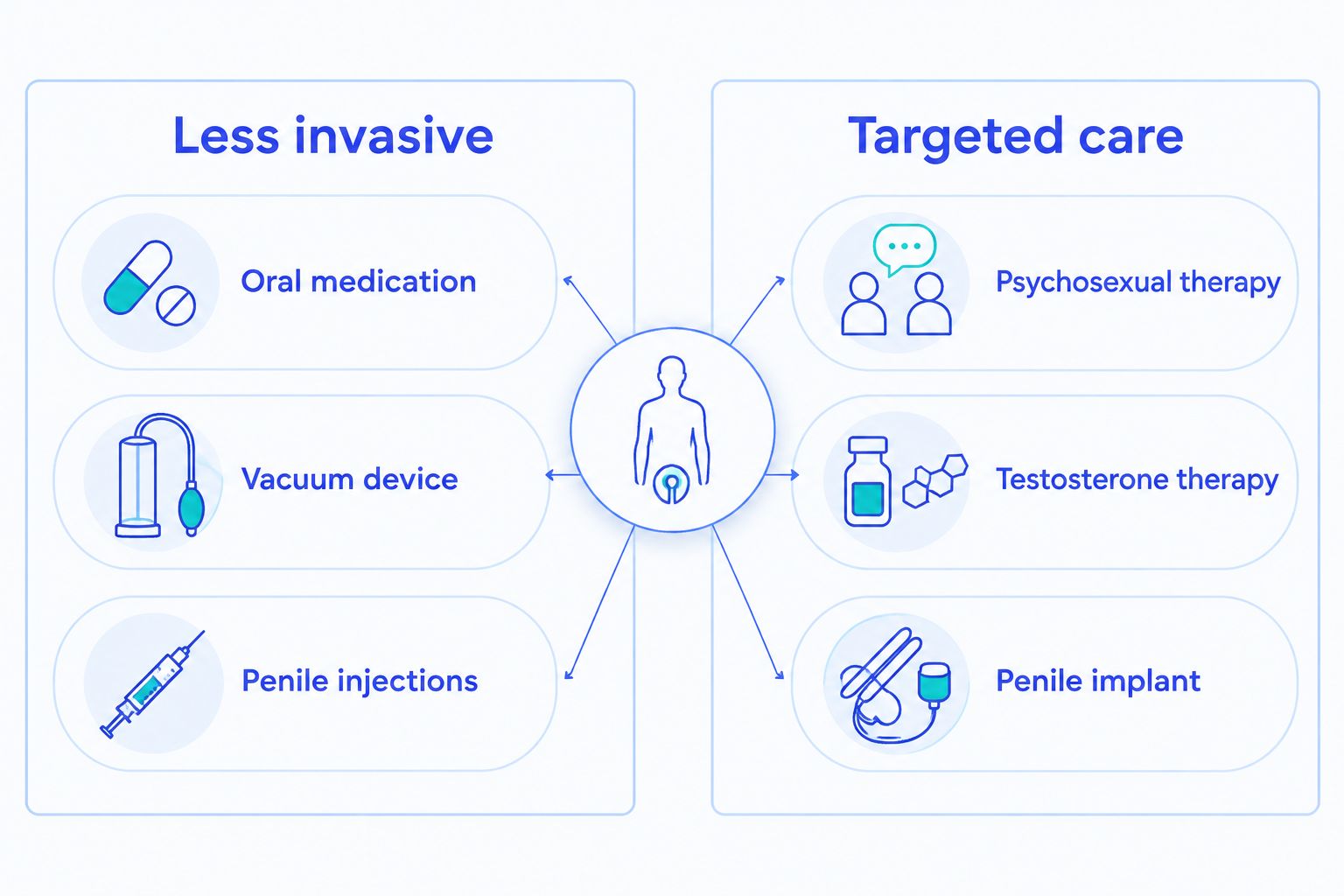
1. Oral PDE5 medication: best first treatment when medically suitable
Sildenafil and tadalafil are PDE5 inhibitors. They support the blood-flow response to sexual stimulation; they do not create an erection without that stimulation or correct every cause of ED. Sildenafil is commonly taken before sex, while tadalafil can have an effect lasting up to 36 hours, depending on the prescribed regimen.
Oral PDE5 medication pros:
- Non-surgical and familiar to many patients.
- Different dosing approaches allow a clinician to match treatment to your circumstances.
- A reasonable first medical option for many men after assessment.
Oral PDE5 medication cons:
- Do not take PDE5 inhibitors with nitrates: the combination can cause a dangerous drop in blood pressure.
- Headache, flushing and nasal congestion can occur.
- An inadequate response may require a review of dose, timing, stimulation and the underlying cause rather than simply changing pills.
Best for: Men seeking a first treatment who have been assessed and can take a PDE5 inhibitor safely. Verdict: Hold until a prescriber checks your medications and cardiovascular history; then make this the first option to discuss.
2. Vacuum erection device: best drug-free, non-surgical option
A vacuum erection device uses a cylinder and pump to draw blood into the penis. A constriction band can then help maintain the erection. The band should not remain in place for more than 30 minutes; follow the device instructions and your clinician’s advice.
Vacuum erection device pros:
- Does not rely on a pill to produce an erection.
- Can be considered when medication is unsuitable or has not worked.
- Avoids surgery and can be discontinued.
Vacuum erection device cons:
- Setup can interrupt spontaneity.
- The penis may feel cool or look different while the band is in place.
- Incorrect use can cause discomfort or bruising; discuss suitability if you have a bleeding disorder or take blood-thinning medication.
Best for: Men who want a drug-free approach or cannot use an oral ED medication. Verdict: Hold until you have instruction on safe use and band timing; choose it if the setup fits your needs.
A device is not a diagnosis. If ED appeared suddenly or you have other symptoms, ask for an assessment instead of using equipment to work around a new problem.
3. Penile injections: best when oral medication is ineffective
Penile injection therapy places medication directly into erectile tissue. It can produce an erection without depending on the same pathway as an oral PDE5 inhibitor, which makes it a distinct option when pills fail or cannot be used. A clinician must prescribe the medication, teach the technique and set the dose.
Penile injections pros:
- Offer a medical option before implant surgery.
- Can be considered after an inadequate response to oral treatment.
- The dose can be assessed and adjusted under clinical direction.
Penile injections cons:
- Self-injection is unacceptable to some men.
- Pain, bruising and scarring can occur.
- A prolonged erection is a medical emergency: seek urgent care if an erection lasts 4 hours.
Best for: Men with ED who have not had a satisfactory result from pills or cannot take them and are comfortable learning injection technique. Verdict: Hold until a clinician prescribes the medication and teaches you exactly how to use it.
Do not copy another person’s dose or combine ED treatments without medical direction. The goal is a usable response at an appropriate dose, not the strongest possible erection.
4. Psychosexual therapy: best for distress or performance anxiety
Psychosexual therapy addresses the thoughts, behaviours and relationship pressures that can affect sexual function. It can be useful whether ED has a psychological component or a physical cause has led to anxiety about the next sexual encounter. It can also sit alongside medical treatment rather than replacing it.
Psychosexual therapy pros:
- Addresses distress that a device or medication does not resolve on its own.
- Can involve a partner when that is appropriate and wanted.
- Does not require a drug or procedure.
Psychosexual therapy cons:
- Takes participation and time rather than producing an immediate erection on demand.
- Does not treat a confirmed hormonal deficiency or reverse a medication-related cause by itself.
- Access to a suitably qualified clinician matters.
Best for: Men whose ED is accompanied by performance anxiety, avoidance or relationship strain. Verdict: Hold off on treating therapy as a substitute for medical assessment; discuss it as part of the plan when distress is present.
ED does not become less real because anxiety plays a part. Conversely, an identifiable physical cause does not make the emotional impact irrelevant. Address both when both are present.
5. Testosterone therapy: best for confirmed testosterone deficiency
Testosterone therapy treats testosterone deficiency; it is not a default prescription for ED. A clinician needs to assess symptoms and confirm low testosterone with appropriate blood testing before considering treatment. If testosterone levels are not low, adding testosterone is not the answer to erectile dysfunction.
Testosterone therapy pros:
- Addresses a documented hormonal issue rather than treating ED without a diagnosis.
- Creates an opportunity to review other symptoms linked to low testosterone.
- Can be considered alongside a separate ED treatment when clinically appropriate.
Testosterone therapy cons:
- Does not reliably resolve ED when low testosterone is not the cause.
- Requires medical monitoring and a discussion of risks and benefits.
- Can suppress sperm production, an important issue if fertility matters to you.
Best for: Men with relevant symptoms and confirmed testosterone deficiency after clinical evaluation. Verdict: Hold unless testing supports the diagnosis; do not use testosterone as an ED shortcut.
This is a useful dividing line in 2026: asking for testosterone because erections have changed is not the same as finding a testosterone deficiency. Testing determines whether hormone treatment belongs in the discussion.
6. Penile implant: best after less invasive options fail
A penile implant is a surgically placed device that allows a man to produce an erection for sexual activity. It is an option for persistent ED when less invasive treatments have failed, are unsuitable or do not meet the patient’s goals. A surgical consultation should cover the implant type, how it is used, recovery and the possibility of further surgery.
Penile implant pros:
- Offers a treatment route when pills, devices or injections do not provide a workable result.
- Does not depend on taking an ED pill before sex.
- Makes the trade-off clear: a surgical solution rather than repeated trials of non-surgical options.
Penile implant cons:
- Requires surgery and carries risks including infection or device problems.
- Is not a reversible trial of treatment.
- Does not automatically resolve concerns about desire, fertility or relationship distress.
Best for: Men with persistent ED who want to discuss surgery after reviewing less invasive options. Verdict: Hold until a surgeon explains the procedure, alternatives and risks in relation to your health and goals.
A penile implant ranks last here because the list follows a typical escalation path, not because surgery is a lesser treatment. For the right patient, the better decision is the one that matches the diagnosis and an informed preference.
How these treatments were ranked
The order starts with a common non-surgical medical option, then separates treatments by the problem each solves. Oral PDE5 medication comes first only when it is safe. A vacuum device offers a drug-free route; injections provide another medical route after pills; therapy and testosterone address specific contributing factors; an implant is reserved for a surgical decision.
That order is a guide to the conversation, not a prescription. In 2026, a man taking nitrates should not start at the top of this list, and a man with confirmed testosterone deficiency should not ignore the diagnosis because hormone treatment appears lower down. AIME provides erectile dysfunction assessment and treatment in Edmonton, so the first move is to establish which branch applies to you.
Which erectile dysfunction treatment should you choose?
Choose a clinical assessment first, then discuss a PDE5 inhibitor if your health and medications allow it. If pills do not fit, ask whether a vacuum device or injection therapy better matches your needs. Bring up anxiety or relationship strain rather than waiting for a pill to solve it; ask about testosterone only when symptoms and testing warrant it.
If ED persists despite less invasive care, discuss whether surgery is appropriate. AIME’s medical and surgical erectile dysfunction care is best suited to men who want that decision tied to a diagnosis, not a blanket claim that one procedure is the best erectile dysfunction treatment in 2026.
Talk to AIME about ED treatment
Men’s sexual health clinic in Edmonton offering medical and surgical erectile dysfunction care.
FAQ
What is the best erectile dysfunction treatment in 2026?
A prescription PDE5 inhibitor is a common first treatment when it is medically safe. The best choice changes if you take nitrates, cannot tolerate medication or have a specific cause that needs treatment.
Can I take erectile dysfunction pills if I use nitrates?
No, PDE5 inhibitors must not be combined with nitrates because blood pressure can fall dangerously. Tell your prescriber about all medicines you take before starting ED treatment.
What if sildenafil does not work for me?
Ask a clinician to review how you used it, your dose, other medicines and the possible cause of ED. A vacuum device, injection therapy or another approach may be more appropriate than repeating an ineffective plan.
Is a vacuum erection device better than ED medication?
A vacuum erection device is a better fit when you want a drug-free option or cannot take oral ED medication. Pills are generally simpler to use, while a device requires setup and attention to band timing.
Will testosterone therapy cure erectile dysfunction?
Testosterone therapy is not a general cure for erectile dysfunction. It is considered when symptoms and blood testing establish testosterone deficiency, and ED may still need separate treatment.
When should I consider a penile implant?
Consider a penile implant discussion when ED persists and less invasive options fail, are unsuitable or do not meet your goals. A surgeon should explain the risks and alternatives before you decide.
When is an erection an emergency?
An erection lasting 4 hours needs urgent medical attention. This risk is especially important to understand before using penile injection therapy.
One last thing
A treatment can improve erections without addressing why ED began. In 2026, the most useful question at your first appointment is not simply which treatment is strongest; it is what is causing the change, and which option is safe for you?