

Best starting option for eligible men: oral medication. Best drug-free erection aid: a vacuum device. Best option for ED linked to performance anxiety: psychosexual therapy. This 2026 guide to ED treatments ranked by invasiveness explains what each option involves and when to discuss it with a clinician at AIME.
- ED treatments ranked by invasiveness run from counselling and non-invasive erection aids to injections and penile implant surgery.
- Oral medication is a common starting treatment, but men taking nitrates must not use PDE5 inhibitors.
- Vacuum devices avoid needles; penile injections require training; implants require surgery and carry irreversible consequences.
- AIME provides erectile dysfunction assessment and treatment for adult men in Edmonton.
Why this matters
Less invasive does not mean safer for every patient, and more invasive does not mean better for everyone. A tablet involves no procedure, but its interaction with nitrate medication can cause a dangerous fall in blood pressure. A vacuum device avoids that interaction, yet still needs correct use.
Erectile dysfunction can reflect vascular disease, diabetes, medication effects, psychological distress or several causes together. Your 2026 treatment decision should start with assessment, not simply the next item on a ladder. Sudden changes, penile pain, curvature and urinary symptoms deserve specific discussion.
What makes the best ED treatment for you?
Use these criteria before comparing options:
- Tissue involvement: Does treatment leave tissue intact, enter the urethra, puncture the penis or require surgery?
- Medical suitability: Do your medicines, cardiovascular health or other conditions rule it out?
- Evidence: Is the treatment established for your situation, or does its benefit remain uncertain?
- Practical burden: Can you use it comfortably, correctly and consistently?
- Reversibility: Can you stop treatment without permanent anatomical changes?
- Treatment goal: Are you addressing erection firmness, anxiety, a contributing illness or several problems?
Invasiveness is only one dimension. A useful choice must also match your health, preferences and the reason erections have changed.
ED treatments at a glance
This ranking moves from treatments without tissue entry to surgical implantation. The non-invasive options share a broad tier: tablets, vacuum devices and low-intensity extracorporeal shockwave therapy do not form a universal sequence that every patient must follow. Shockwave therapy appears separately because its evidence and role differ from established erection aids.
| Rank and option | Best for | Main feature | Key limitation |
|---|---|---|---|
| 1. Lifestyle and psychosexual treatment | Addressing contributing health factors or performance anxiety | No penile instrumentation | Does not reliably provide an immediate erection |
| 2. Oral PDE5 inhibitors | Eligible men seeking a common initial medical treatment | Medication supports the erection response | Unsafe with nitrates; response varies |
| 3. Vacuum erection device | Men seeking a drug-free erection aid | External suction draws blood into the penis | Mechanical setup and constriction-ring discomfort |
| 4. Li-ESWT | Selected men discussing an uncertain-evidence option | External application of acoustic energy | Benefit is not established for every ED cause |
| 5. Intraurethral alprostadil | Men discussing an alternative to tablets and injections | Medication enters through the urethra | Urethral discomfort and variable response |
| 6. Intracavernosal injections | Men needing a medication option when tablets fail | Medication is injected into erectile tissue | Needle use and risk of prolonged erection |
| 7. Penile implant | Men seeking a surgical option after other treatments are unsuitable | Implanted components create rigidity | Surgery, infection risk and irreversible tissue changes |
For a broader comparison beyond invasiveness, see the guide to erectile dysfunction treatments.
1. Lifestyle and psychosexual treatment: best for contributing causes
Lifestyle changes address factors such as smoking, inactivity and cardiovascular health. Psychosexual therapy addresses performance anxiety, sexual distress and relationship patterns that affect erections. These approaches can accompany medical treatment rather than replace it.
Best for: Men whose ED includes modifiable health factors, anxiety or relationship difficulties.
Lifestyle and psychosexual treatment pros:
- Avoids needles, devices and surgery.
- Addresses factors that erection aids alone do not resolve.
- Can support treatment adherence and communication with a partner.
Lifestyle and psychosexual treatment cons:
- Does not provide a predictable erection on demand.
- Does not replace assessment for physical causes of ED.
Ask your clinician which changes apply to your diagnosis. Do not stop a prescribed medicine because you suspect it affects erections; discuss an alternative with the prescriber.
Verdict: Choose this foundation when relevant, but do not delay medical assessment while waiting for improvement.
2. Oral PDE5 inhibitors: best for an initial medication trial
Sildenafil and tadalafil are examples of phosphodiesterase type 5 inhibitors. These medicines support blood flow during sexual stimulation; they do not automatically produce an erection or increase sexual desire. Your clinician selects the medicine and instructions around your health and other prescriptions.
Best for: Men who can safely take PDE5 inhibitors and want treatment without a penile procedure.
Oral PDE5 inhibitor pros:
- Requires no penile instrumentation.
- Is an established treatment category for ED.
- Offers different timing and dosing approaches under medical guidance.
Oral PDE5 inhibitor cons:
- Must not be combined with nitrates or recreational nitrites, including poppers.
- Can cause headache, flushing, indigestion and other adverse effects.
- Does not work adequately for every patient.
Before calling a tablet ineffective, review timing, sexual stimulation, food-related instructions and the prescribed regimen with your clinician. Taking extra doses without advice is not a substitute for that review.
Verdict: Choose oral medication as a common starting treatment when your clinician confirms it is safe.
3. Vacuum erection device: best for a drug-free erection aid
A vacuum erection device uses an external cylinder and suction to draw blood into the penis. A constriction ring can then help maintain the erection after the cylinder is removed. No medication enters the body, but the device still needs careful instruction.
Best for: Men who prefer a mechanical option or cannot use oral ED medication.
Vacuum erection device pros:
- Avoids systemic medication and penile injections.
- Can be used independently of sexual arousal to create engorgement.
- Can form part of a clinician-directed treatment plan alongside other approaches.
Vacuum erection device cons:
- Can cause bruising, numbness or discomfort.
- Requires setup and can interrupt sexual activity.
- The erection can feel different from an unassisted erection.
Do not leave a constriction ring on for more than 30 minutes. Follow the device instructions and seek advice about suitability if you have a bleeding disorder or take anticoagulants.
Verdict: Choose a vacuum device when avoiding medication matters more than avoiding mechanical setup.
4. Li-ESWT: best for a specialist discussion, not a default
Low-intensity extracorporeal shockwave therapy applies acoustic energy externally. It is studied particularly for vasculogenic ED, where impaired blood flow contributes to erection difficulties. Its non-invasive delivery does not establish that it will work for your diagnosis.
Best for: Selected men with vasculogenic ED who understand the uncertainty and discuss the evidence with a specialist.
Li-ESWT pros:
- Does not require penile injections or implantation.
- Has been studied as a treatment directed at vascular contributors.
- Provides a non-surgical topic to discuss when reviewing alternatives.
Li-ESWT cons:
- Treatment protocols and study results vary.
- Durable benefit is not established for every patient group.
- Radial pressure-wave services are not interchangeable with the shockwave treatments studied in clinical trials.
For a 2026 decision, ask which technology is proposed, why your diagnosis fits and how improvement will be assessed. Do not treat promises of a permanent cure as evidence.
Verdict: Hold until a specialist explains the evidence, uncertainties and relevance to your ED.
5. Intraurethral alprostadil: best for avoiding penile injections
Intraurethral alprostadil delivers medication through the urethral opening rather than through a needle into erectile tissue. It is more locally intrusive than a tablet or external device. A clinician must explain suitability, administration and precautions.
Best for: Men discussing a local medication alternative when tablets are unsuitable or inadequate and injections are unacceptable.
Intraurethral alprostadil pros:
- Avoids a needle puncture into erectile tissue.
- Offers a different mechanism from oral PDE5 inhibitors.
- Does not require surgical implantation.
Intraurethral alprostadil cons:
- Can cause urethral burning, penile discomfort or minor bleeding.
- Response can be inadequate.
- Requires careful administration and product-specific precautions.
Discuss partner-related precautions, including pregnancy considerations, with the prescriber. Do not assume that a locally administered medicine has no effects elsewhere in the body.
Verdict: Consider intraurethral treatment when its administration method fits your preferences and medical assessment.
6. Intracavernosal injections: best when tablets are inadequate
Intracavernosal injection therapy places prescribed medication directly into the erectile tissue. Alprostadil is one example. Treatment requires hands-on instruction, clinician-directed dose adjustment and a clear plan for a prolonged erection.
Best for: Men who need an established non-surgical medication option after oral treatment is inadequate or unsuitable.
Intracavernosal injection pros:
- Delivers medication directly to the target tissue.
- Can work when oral treatment does not provide adequate rigidity.
- Avoids implant surgery.
Intracavernosal injection cons:
- Can cause pain, bruising and scarring.
- Carries a risk of priapism, a prolonged erection requiring urgent care.
- Requires confidence with injection technique and prescribed dosing.
An erection lasting 4 hours is a medical emergency. Follow your prescriber's earlier action instructions and seek emergency care at that threshold; do not wait for it to become painful.
Verdict: Choose injections only with prescribing, practical training and an emergency plan.
7. Penile implant: best for a considered surgical decision
A penile implant places components inside the penis to provide rigidity. Inflatable implants use paired cylinders; a common inflatable design has 2 cylinders within the erectile bodies. Malleable implants use bendable rods instead.
Best for: Men whose other treatments are ineffective, unsuitable or unacceptable and who understand surgery's consequences.
Penile implant pros:
- Provides a mechanical means of creating rigidity.
- Avoids taking or administering erection medication for each use.
- Offers an established surgical option for appropriately selected patients.
Penile implant cons:
- Requires surgery and recovery.
- Carries infection, mechanical failure and possible revision risks.
- Alters erectile tissue irreversibly and does not automatically improve desire, sensation or orgasm.
Ask about implant type, expected changes in penile appearance or perceived length, recovery restrictions and future revision. Implant surgery is not a temporary trial: removal does not simply restore your previous erectile function.
Verdict: Choose an implant only after detailed surgical counselling and a clear review of alternatives.
How these ED treatments were ranked
The 2026 ranking uses tissue involvement first: no tissue entry, urethral administration, needle penetration and surgical implantation. Within the non-invasive tier, the sequence reflects common treatment discussions rather than a measured difference in invasiveness.
This is not an effectiveness leaderboard. A suitable injection can be more useful than an unsuitable tablet, while psychosexual therapy can remain valuable alongside either. The ranking also does not establish that every listed treatment is offered by AIME.
Which ED treatment should you choose?
For an undecided patient, start with diagnosis and a safety review—not the most advanced procedure. AIME provides erectile dysfunction assessment and treatment for adult men in Edmonton. Bring a medication list, describe when erections changed and explain what you want treatment to make possible.
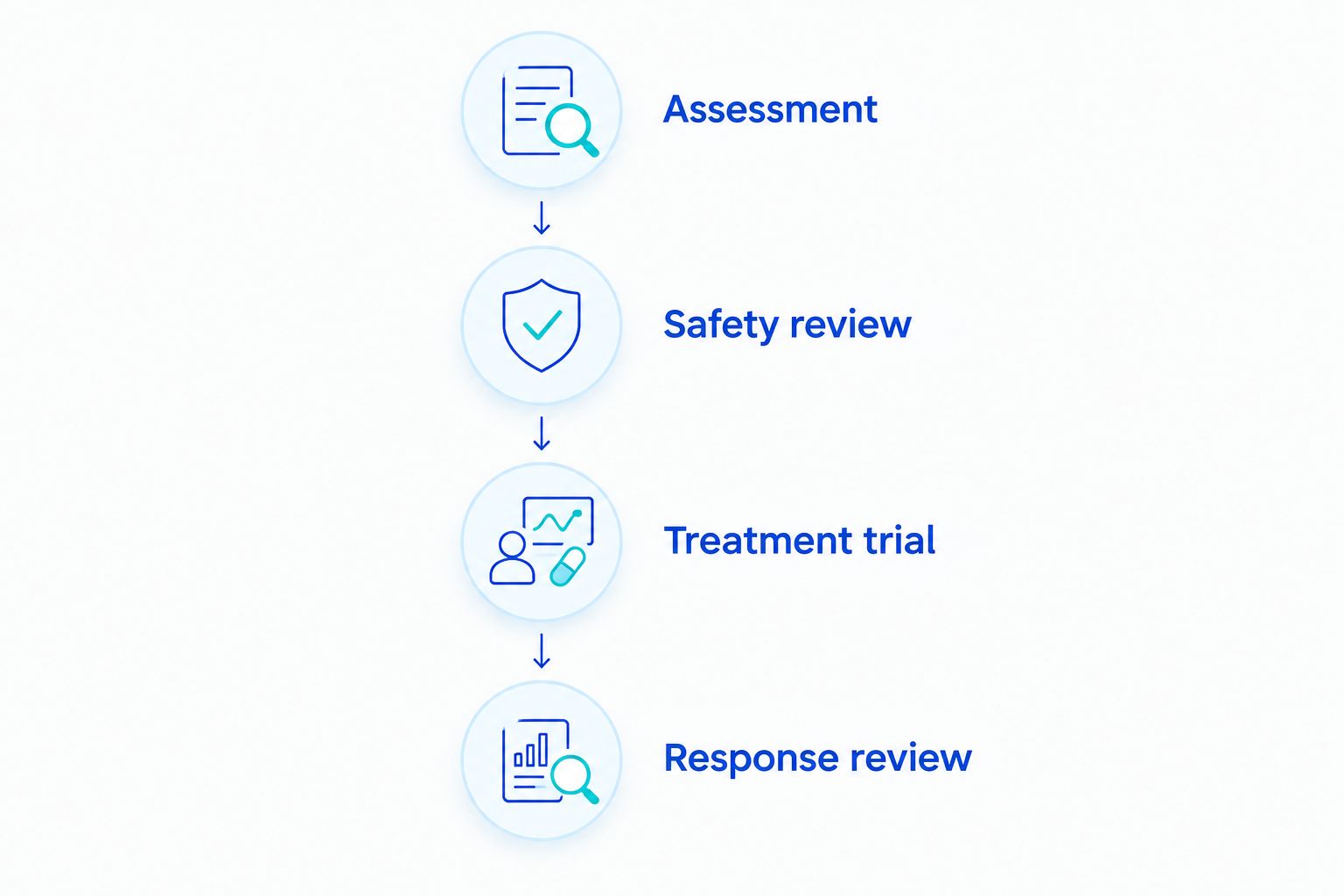
Use this sequence to structure your 2026 appointment:
- Assessment: Identify contributing conditions, medicines and sexual symptoms.
- Safety review: Check contraindications and whether sexual activity requires cardiovascular assessment.
- Treatment trial: Agree on a suitable approach and instructions.
- Response review: Discuss benefit, adverse effects and whether to change treatment.
If you already tried treatment, explain exactly how you used it and what happened. That information helps distinguish an inadequate response from an administration problem, an adverse effect or a mismatch with your goals.
Discuss your ED treatment options
Explore AIME’s men’s sexual health care and discuss assessment before selecting treatment.
FAQ
What are the least invasive ED treatments?
Lifestyle measures, psychosexual therapy, oral medicines and external devices avoid penile tissue entry. They differ in safety, evidence and practical demands, so non-invasive does not mean suitable for everyone.
What’s the best ED treatment to try first?
Oral PDE5 inhibitors are a common initial medical treatment for eligible men. Assessment comes first, and men taking nitrates must not use these medicines.
Is a vacuum pump less invasive than ED injections?
Yes, a vacuum erection device acts externally, while an injection punctures erectile tissue. Vacuum devices still require correct use; a constriction ring must not remain on for more than 30 minutes.
Is shockwave therapy a proven cure for erectile dysfunction?
No, Li-ESWT is not an established universal cure for erectile dysfunction. Studies focus on selected patient groups, and protocols, responses and evidence of lasting benefit vary.
When should I consider penile injections?
Discuss penile injections when oral treatment is inadequate or unsuitable and you want a non-surgical medication option. Prescribing, technique training and instructions for prolonged erections are essential.
Does a penile implant make the penis larger?
A penile implant treats erection rigidity, not cosmetic enlargement. Discuss expected appearance, perceived length, sensation and the irreversible nature of surgery with the surgeon.
Do I have to try every ED treatment before surgery?
No, treatment selection depends on suitability, previous response and informed preferences rather than a mandatory sequence. Your clinician should explain reasonable alternatives before a surgical decision.
What should I bring to an ED appointment in 2026?
Bring your medication list and a clear account of your symptoms and previous treatments. Include penile pain or curvature, urinary changes, morning erections and any treatment-related adverse effects.
One last thing
Penile girth, penile curvature and erection rigidity are different treatment goals. An enhancement procedure is not automatically an ED treatment, and improving firmness does not necessarily correct Peyronie's disease. Tell your clinician which problem limits sexual activity so the treatment addresses the right outcome.
Related guides