

Best for dependable erections after other treatments fail: penile implants. Best first-line option: oral PDE5 inhibitors. Best medication-free option: vacuum erection devices. This 2026 guide to ED treatments ranked by success rate separates erection reliability from satisfaction and helps you prepare for a clinical assessment at AIME.
- ED treatments ranked by success rate need comparable outcomes, not a single percentage league table.
- Penile implants offer dependable mechanical erections but require surgery and permanently change erectile tissue.
- Oral PDE5 inhibitors are a usual first-line treatment; nitrates make their use unsafe.
- AIME provides erectile dysfunction assessment and treatment for adult men seeking clinical care in Edmonton.
Why this matters
An erection response, successful intercourse and treatment satisfaction are different outcomes. A treatment can produce an erection yet remain unacceptable because of discomfort, preparation or recovery. Another can improve confidence without correcting a physical cause.
For your 2026 decision, compare treatments against your diagnosis and priorities. Diabetes, vascular disease, pelvic surgery, medication effects and performance anxiety can influence the choice. Persistent erectile dysfunction also warrants assessment for cardiovascular risk factors; treating the symptom alone misses part of the clinical picture.
This ranking therefore uses distinct treatment roles rather than unsupported head-to-head percentages. It does not suggest that surgery should come before a suitable trial of less invasive care.
What makes the best erectile dysfunction treatment?
- Relevant outcome: Does success mean erection firmness, penetration, satisfaction or continued use?
- Appropriate diagnosis: Does the treatment address your physical, hormonal or psychological contributors?
- Safety: Review cardiovascular health, current medicines and contraindications before choosing treatment.
- Reliability: Consider whether the treatment works consistently under conditions you can manage.
- Treatment burden: Account for preparation, device handling, injections, recovery and follow-up.
- Reversibility: Distinguish treatments you can stop from surgery that permanently changes erectile tissue.
Ask for success figures from patients with a diagnosis similar to yours. A study of selected surgical patients cannot establish how tablets will work for someone with mild, newly diagnosed ED.
ED treatments at a glance
The order below reflects distinct clinical strengths, not a universal numerical success ranking. Your assessment can change which option belongs first.
| Rank and treatment | Best for | Standout feature | Key limitation |
|---|---|---|---|
| 1. Penile implants | Dependable mechanical erections after other options fail | An implanted device creates rigidity | Surgery and permanent tissue changes |
| 2. Oral PDE5 inhibitors | First-line medical treatment when suitable | Support the erection response to sexual stimulation | Unsafe with nitrates; response varies |
| 3. Intracavernosal injections | An erection response when tablets are unsuitable or ineffective | Medication acts directly within erectile tissue | Injection training and priapism risk |
| 4. Vacuum erection devices | A medication-free erection aid | Mechanical blood draw with a constriction ring | Handling, discomfort and altered sensation |
| 5. Psychosexual therapy | Anxiety-related or relationship-related contributors | Addresses psychological barriers to sexual function | Does not directly reverse structural disease |
| 6. Testosterone treatment | ED with confirmed testosterone deficiency | Treats a documented hormonal problem | Not a general ED treatment |
| 7. Li-ESWT | Discussion of a less-established option for selected vascular ED | Applies low-intensity shockwaves | Protocols and evidence remain variable |
1. Penile implants: best for dependable mechanical erections
A penile implant places a device inside the penis to create rigidity. Inflatable and malleable designs work differently, but both require surgery. An implant is an option when other treatments are ineffective, unacceptable or unsuitable.
Its position here reflects mechanical dependability, not first-line suitability. An implant does not restore normal erectile tissue, increase sexual desire or guarantee satisfaction. Your expectations about appearance, sensation and device use matter.
Penile implant pros:
- Creates rigidity without relying on a tablet response.
- Offers an option after unsuccessful medical treatment.
- Allows an erection through operation or positioning of the device.
Penile implant cons:
- Requires surgery, recovery and discussion of infection risk.
- Permanently changes erectile tissue; device problems can require further surgery.
Best for: Men with persistent ED who understand the trade-offs and want to discuss surgical treatment.
Verdict: Hold until a specialist assessment confirms that surgery fits your treatment history and goals. Dependability alone does not make an implant the right starting point.
2. Oral PDE5 inhibitors: best for first-line medical treatment
PDE5 inhibitors include sildenafil and tadalafil. They support the blood-flow response to sexual stimulation; they do not automatically create an erection or increase desire. Your clinician selects treatment around your health, medicines and preferred timing.
Sildenafil is generally taken about 30–60 minutes before sexual activity. Tadalafil can support an erection response for up to 36 hours; that does not mean an erection lasts that long. These timing distinctions, described in prescribing and patient information, matter when planning treatment in 2026.
Oral PDE5 inhibitor pros:
- Avoids injections and surgery.
- Offers different timing patterns according to the medicine.
- Can be adjusted under clinical guidance when the initial approach is unsuitable.
Oral PDE5 inhibitor cons:
- Must not be combined with nitrates because blood pressure can fall dangerously.
- Can cause headache, flushing, indigestion and other medicine-specific adverse effects.
Best for: Men seeking an initial medical treatment without a contraindication.
Verdict: Hold off on declaring tablets ineffective until correct use has been reviewed. Timing, stimulation and food instructions can affect the result. Do not increase doses or combine medicines yourself.
3. Intracavernosal injections: best when tablets do not work
Intracavernosal injection therapy delivers medication into erectile tissue. Alprostadil is one example; the prescribed medicine and dose require individual assessment. Unlike tablets, injections act directly at the treatment site.
Training is part of treatment, not an optional extra. You need instructions on injection technique, dose limits and what to do if an erection persists. Your clinician should also explain how to recognise complications.
Intracavernosal injection pros:
- Offers a different mechanism when tablets are ineffective.
- Can be considered when oral medication is unsuitable.
- Allows clinician-guided adjustment of the prescribed dose.
Intracavernosal injection cons:
- Requires a needle, preparation and confidence with technique.
- Can cause pain, bruising, scarring or a prolonged erection requiring urgent care.
Best for: Men who need an alternative medical approach and can follow injection instructions safely.
Verdict: Hold until you receive supervised instruction and an emergency plan. A strong erection response is not a safe result if the dose produces a prolonged erection.
4. Vacuum erection devices: best for medication-free assistance
A vacuum erection device draws blood into the penis using a cylinder and pump. A constriction ring helps maintain the erection after the cylinder is removed. This provides mechanical assistance rather than correcting the underlying cause of ED.
Use a device intended for erectile dysfunction and follow its instructions. Do not leave a constriction ring on for longer than 30 minutes, consistent with patient guidance from the US National Institute of Diabetes and Digestive and Kidney Diseases. Discuss suitability if you have a bleeding disorder or take anticoagulants.
Vacuum erection device pros:
- Avoids systemic ED medication.
- Does not require penile surgery.
- Provides an option when drug treatment is unsuitable.
Vacuum erection device cons:
- Requires preparation and manual handling.
- Can cause bruising, discomfort, coolness or altered sensation.
Best for: Men who prefer a medication-free erection aid and accept the practical steps.
Verdict: Hold until device suitability and ring safety are clear. The best device is one you can operate correctly and comfortably, not simply one that creates rigidity.
5. Psychosexual therapy: best for anxiety-related contributors
Psychosexual therapy addresses performance anxiety, avoidance, relationship strain and other psychological contributors to ED. It can accompany medical treatment when physical and psychological factors overlap. Counselling is not a claim that symptoms are imaginary.
An erection problem can create anxiety even when it began with a physical condition. Treating that cycle can support sexual confidence, communication and continued treatment use. Medical assessment still matters.
Psychosexual therapy pros:
- Addresses anxiety and avoidance directly.
- Can include communication and relationship concerns.
- Can be combined with medication or other treatment.
Psychosexual therapy cons:
- Requires participation and willingness to discuss sensitive issues.
- Does not directly correct severe vascular damage or a structural penile problem.
Best for: Men whose ED includes performance anxiety, distress or relationship-related difficulties.
Verdict: Skip the either-or choice between counselling and medical care. Combined treatment can address different contributors without dismissing the physical symptoms.
6. Testosterone treatment: best for confirmed deficiency
Testosterone treatment addresses documented testosterone deficiency, not erectile dysfunction in every patient. Diagnosis requires symptoms and appropriate blood testing interpreted by a clinician. A single unexplained result is not enough to choose treatment.
Low testosterone can affect sexual desire and contribute to sexual difficulties. Replacing testosterone does not remove every other cause of ED, so erection-specific treatment can still be necessary.
Testosterone treatment pros:
- Addresses a confirmed hormonal deficiency.
- Can improve deficiency-related sexual symptoms.
- Places hormonal symptoms within a monitored medical treatment plan.
Testosterone treatment cons:
- Is inappropriate as a general treatment for men without confirmed deficiency.
- Can suppress sperm production and requires monitoring for adverse effects.
Best for: Men with symptoms and a clinician-confirmed diagnosis of testosterone deficiency.
Verdict: Skip testosterone as an untested shortcut to better erections. Discuss fertility plans before treatment, because preserving sperm production can change the recommendation.
7. Li-ESWT: best discussed as a less-established option
Low-intensity extracorporeal shockwave therapy, or Li-ESWT, applies shockwaves to penile tissue. It has been studied particularly in vascular ED, but patient selection, equipment, treatment protocols and measured outcomes differ. Acoustic-wave marketing should not be treated as proof that a device matches a studied protocol.
For a 2026 decision, distinguish a proposed benefit from a dependable personal outcome. The American Urological Association's ED guideline describes low-intensity shockwave treatment as investigational; European Association of Urology guidance allows more selective consideration. That difference deserves discussion rather than a guaranteed success claim.
Li-ESWT pros:
- Does not require implantation of a device.
- Offers a non-surgical approach for clinical discussion.
- Has published research in selected men with vascular ED.
Li-ESWT cons:
- Evidence and protocols do not support a universal success percentage.
- Durable benefit for an individual patient cannot be guaranteed.
Best for: Selected men discussing vascular ED who understand the evidence limitations.
Verdict: Wait before treating Li-ESWT as equivalent to established erection aids. Ask which protocol is proposed, why it fits your diagnosis and how improvement will be measured.
How this ranking works
This 2026 ranking prioritises treatment role, reliability, safety and burden. It does not pool satisfaction surveys, erection-response studies and procedure outcomes into a misleading percentage table. The clinical reference points are the American Urological Association's Erectile Dysfunction Guideline (2018), European Association of Urology guidance on sexual and reproductive health, prescribing information for sildenafil and tadalafil, and NIDDK patient guidance on ED treatment.
Those sources address different questions. Prescribing information explains medicine use and contraindications; guidelines assess treatment choices; patient guidance explains practical safety. None can predict your individual result without an assessment.
Which erectile dysfunction treatment should you choose?
For an undecided patient in 2026, clinical assessment comes before choosing the highest-ranked procedure. Bring your medication list, relevant health history and details of previous treatment attempts. Explain whether your priority is spontaneity, avoiding medication, consistent firmness or reducing anxiety.
AIME is a men's sexual health clinic for adult men seeking assessment and treatment of erectile dysfunction in Edmonton. Use the consultation to connect your diagnosis with the treatment's purpose, risks and follow-up requirements.
A useful decision sequence is:
- Medical history: Identify health conditions, medicines and previous responses.
- Treatment goals: Define what a satisfactory result means to you.
- Safety review: Check contraindications and procedure-specific risks.
- Treatment choice: Select an appropriate option together.
- Follow-up: Review response, adverse effects and practical difficulties.
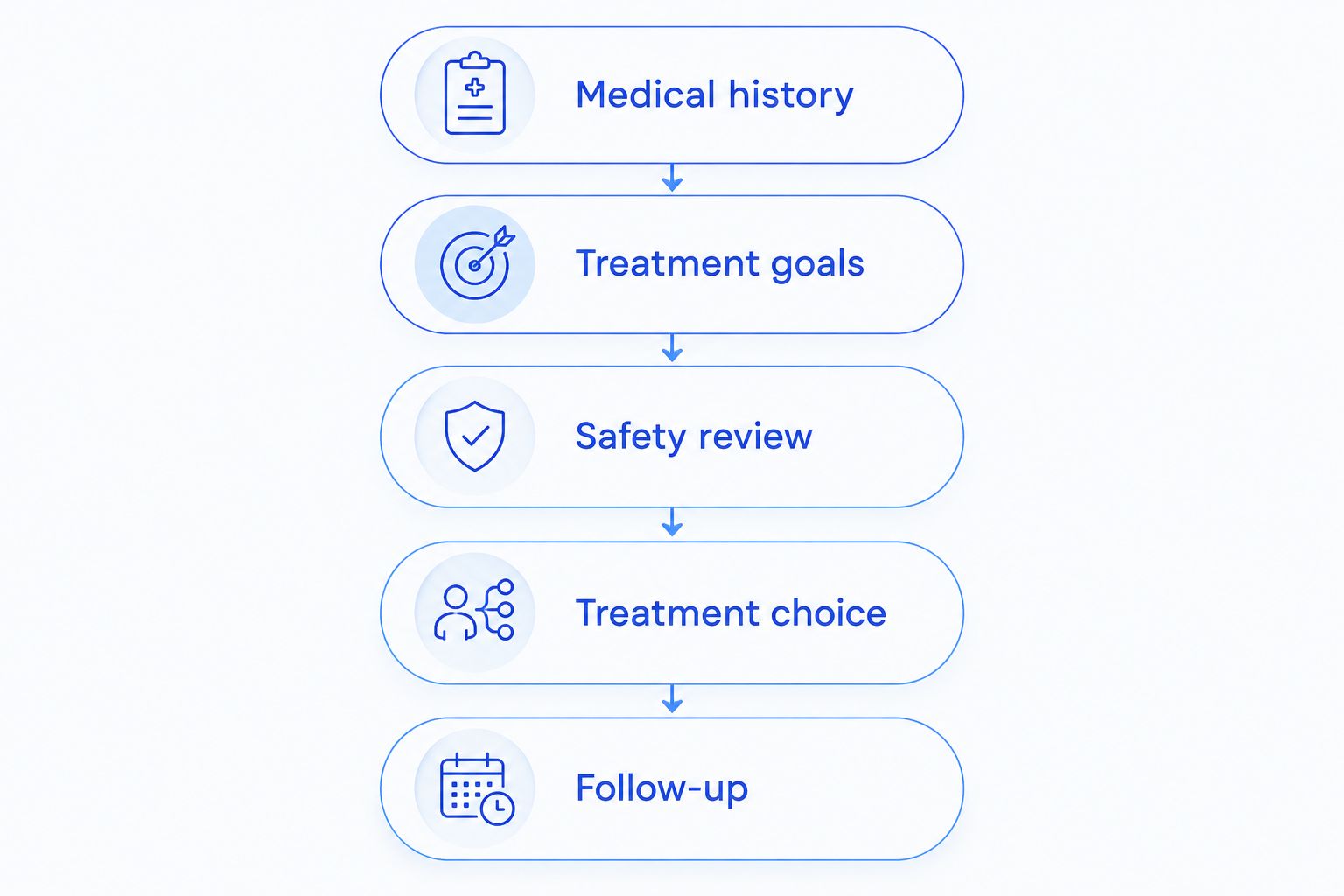
Agree on what to record before follow-up. Firmness, discomfort, ease of use and whether you want to continue all matter; a single successful attempt does not answer every treatment question.
FAQ
What’s the ED treatment with the highest success rate?
There is no single comparable success rate across all ED treatments. Penile implants provide dependable mechanical rigidity, but surgery, satisfaction and complications must be assessed separately from tablet response.
Are ED tablets usually the first treatment to try?
Oral PDE5 inhibitors are a usual first-line medical treatment when suitable. A clinician must check contraindications, including nitrate use, and explain correct administration.
Are penile injections better than sildenafil?
Penile injections offer a different mechanism when sildenafil is ineffective or unsuitable. They require training and carry risks including pain and prolonged erections, so better depends on your diagnosis and priorities.
Can I treat erectile dysfunction without medication?
Vacuum erection devices provide medication-free erection assistance. Psychosexual therapy can address anxiety-related contributors, but persistent ED still needs medical assessment.
Does testosterone treatment cure erectile dysfunction?
Testosterone treatment is not a general cure for erectile dysfunction. It treats confirmed testosterone deficiency, and other causes of ED can still require separate treatment.
Is shockwave therapy a guaranteed cure for ED?
Li-ESWT is not a guaranteed cure for erectile dysfunction. Evidence varies by patient selection and protocol, and professional guidance differs on its clinical role.
When does an erection need emergency treatment?
An erection lasting 4 hours or longer needs emergency medical assessment. This is especially important after injection treatment because prolonged erections can damage erectile tissue.
One last thing
Choose the outcome before choosing the treatment. Tell your clinician whether you want reliable firmness, less preparation, reduced anxiety or a treatment you can continue comfortably. That makes a success-rate discussion more useful than a headline percentage.
Related guides
- Erectile dysfunction treatment options
- Non-surgical treatments for Peyronie's disease
- Enlarged prostate treatment options