

Best overall for avoiding a healing period: oral ED medication, when medically appropriate. Best medication-free option: a vacuum erection device. Best alternative when tablets are unsuitable or ineffective: prescribed penile injections. This 2026 ED treatment recovery time comparison ranks options by tissue healing and interruption to daily life—not by how quickly they produce an erection.
- This ED treatment recovery time comparison puts oral medication and vacuum devices ahead of surgery for avoiding wound healing.
- Penile injections require training and safety precautions, despite having no surgical recovery period.
- Penile implants require postoperative healing; sexual activity generally resumes after clinician clearance at four to six weeks.
- AIME provides erectile dysfunction assessment for adult men who need a medically appropriate treatment plan.
Why recovery time matters
A treatment can require no wound healing and still cause side effects that interrupt your day. Another can work quickly but require careful training before you use it safely. Recovery, onset of action and treatment duration answer different questions.
AIME is a men's sexual health clinic for adult men seeking assessment and treatment of erectile dysfunction. Start with AIME if you need a diagnosis rather than another comparison of devices or medications. Erectile dysfunction can involve vascular health, medication effects, nerve function, hormones or psychological factors; choosing treatment without assessing those factors misses the underlying problem.
For your 2026 decision, use downtime to narrow the choices—not to choose a treatment that conflicts with your medical history. This ranking does not establish which option your clinician should prescribe.
What makes the best low-recovery ED treatment?
A useful comparison separates these criteria:
- Tissue healing: Does treatment create an incision, puncture or local irritation?
- Daily activity: Does treatment require time away from work, exercise or driving?
- Sexual activity: Can you use the treatment during sex, or must you wait for healing and clearance?
- Safety requirements: Do you need medication screening, supervised instruction or an emergency plan?
- Treatment burden: Is treatment used as needed, taken regularly or delivered over repeated appointments?
- Clinical suitability: Does the option address erectile dysfunction with evidence appropriate to your situation?
The fastest recovery is not automatically the best treatment. A method you cannot use safely, comfortably or effectively is a poor choice even when it involves no surgery.
ED treatments at a glance
This 2026 ranking places treatments without surgical healing first. The order within that group reflects local tissue effects and practical restrictions, not a measured difference in recovery days. Several options are effectively tied for avoiding postoperative recovery.
| Rank and treatment | Best for | Standout feature | Recovery considerations | Key limitation |
|---|---|---|---|---|
| 1. Oral PDE5 inhibitors | Avoiding procedures | Medication taken by mouth | No incision or wound-healing period | Contraindicated with nitrate medicines |
| 2. Vacuum erection device | Medication-free treatment | Mechanical assistance with an erection | No surgical healing; bruising or discomfort can occur | Constriction ring requires strict time limits |
| 3. Penile injections | An alternative when tablets fail | Medication delivered directly into erectile tissue | No surgical incision; puncture soreness or bruising can occur | Training and a prolonged-erection safety plan are essential |
| 4. Intraurethral alprostadil | Avoiding a penile needle | Medication delivered through the urethra | No surgical healing; local irritation can occur | Urethral pain or burning can limit use |
| 5. Low-intensity shockwave therapy | Discussing a non-incisional approach | External treatment sessions | No surgical wound; treatment course is separate from recovery | Investigational status limits routine recommendation |
| 6. Penile implant surgery | A surgical option after other treatments fail | An implanted erection-support device | Postoperative healing and restrictions are necessary | Surgery carries infection and device-related risks |
1. Oral PDE5 inhibitors: best ED treatment for avoiding procedures
Oral phosphodiesterase type 5 inhibitors include sildenafil and tadalafil. They support the blood-flow response involved in an erection and require sexual stimulation; they do not create an automatic erection.
There is no incision to heal. That makes oral medication a practical starting discussion when you want to avoid procedural recovery, but its suitability depends on your medical history and other medicines.
Oral PDE5 inhibitor pros:
- No injection or surgical wound.
- No device placement during sexual activity.
- Different prescribing schedules can fit different treatment needs.
Oral PDE5 inhibitor cons:
- Headache, flushing, indigestion and other adverse effects can occur.
- Nitrate medicines must not be combined with PDE5 inhibitors because blood pressure can fall dangerously.
- Medication does not work adequately for every patient.
Best for: Adults who want a non-procedural option and have no contraindication to the prescribed medication.
Verdict: Consider first with your clinician when avoiding tissue recovery is the priority. Do not choose or change a dose based on a recovery-time ranking.
2. Vacuum erection device: best ED treatment for avoiding medication
A vacuum erection device draws blood into the penis using negative pressure. A constriction ring helps maintain the erection after the cylinder is removed.
The device does not involve an operation, so there is no postoperative healing period. However, mechanical pressure and the ring can cause discomfort, bruising or numbness. Proper fit and instruction matter more than the absence of an incision.
Vacuum erection device pros:
- Medication-free method of supporting an erection.
- No surgical wound.
- Used when needed rather than requiring a treatment course.
Vacuum erection device cons:
- Setup can interrupt sexual activity.
- The erection can feel different from an unassisted erection.
- Bruising and discomfort are possible, particularly when technique or suitability is poor.
Best for: Adults seeking a mechanical option who can use the device and ring safely.
Verdict: Consider for medication-free treatment, but do not mistake no surgery for no precautions. American Urological Association patient guidance advises removing the constriction ring within 30 minutes. Follow the device instructions and your clinician's advice, including screening for bleeding risks.
3. Penile injections: best ED treatment when tablets are insufficient
Intracavernosal injection therapy delivers prescribed medication directly into the erectile tissue. Your clinician selects the medication and dose and teaches the injection technique.
A small puncture is not equivalent to a surgical incision. You usually do not have an operation-related recovery period, but local pain, bleeding or bruising can follow an injection. Training is part of treatment—not an optional extra.
Penile injection pros:
- An alternative when oral medication is ineffective or unsuitable.
- No implanted device or surgical wound.
- Dose and technique are individualized under medical supervision.
Penile injection cons:
- Requires a needle and careful technique.
- Can cause pain, bruising or tissue scarring.
- Can cause a prolonged erection requiring urgent treatment.
Best for: Adults who need an alternative to tablets and accept injection training and safety precautions.
Verdict: Consider after assessment, not as a self-directed shortcut to faster recovery. An erection lasting 4 hours is a medical emergency, especially following ED medication or an injection. Do not wait overnight for it to resolve.
4. Intraurethral alprostadil: best ED treatment for avoiding injections
Intraurethral alprostadil delivers medication through the urethra rather than through a penile injection. It is a distinct delivery method, not another name for oral medication.
There is no surgical incision to heal. Local burning, aching or irritation can nevertheless make it less comfortable than the recovery label suggests. Your clinician should explain administration, precautions and what to do if symptoms persist.
Intraurethral alprostadil pros:
- Avoids a needle into erectile tissue.
- Does not require implant surgery.
- Offers a different medication route when discussing alternatives to tablets.
Intraurethral alprostadil cons:
- Urethral pain or burning can occur.
- Administration takes instruction and practice.
- Dizziness and prolonged erections are possible.
Best for: Adults considering local medication who prefer to avoid penile injections.
Verdict: Discuss as an alternative delivery route, not as a guaranteed faster or better treatment. The absence of surgical healing does not establish comfort, effectiveness or suitability.
5. Low-intensity shockwave therapy: best for an evidence-focused discussion
Low-intensity extracorporeal shockwave therapy, or Li-ESWT, applies acoustic energy externally. It differs from oral medication, injections and an implanted device because it is delivered as a treatment course rather than simply used to support an individual erection.
For this 2026 comparison, the key distinction is between no surgical wound and an established treatment recommendation. The American Urological Association erectile dysfunction guideline classifies low-intensity shockwave therapy as investigational. Minimal incision-related downtime does not resolve questions about patient selection, protocols or durability of benefit.
Li-ESWT pros:
- Does not require an incision.
- Does not place a permanent implant.
- Avoids self-injection as its delivery method.
Li-ESWT cons:
- Investigational status limits routine recommendation.
- Repeated appointments create a treatment burden even without wound healing.
- Protocol differences make broad promises of lasting benefit inappropriate.
Best for: Adults discussing the evidence, uncertainties and suitability of a non-incisional treatment with a qualified clinician.
Verdict: Hold until the evidence and treatment rationale are explained clearly. Do not select Li-ESWT solely because it is described as having little downtime, and do not assume every treatment marketed as acoustic wave therapy is equivalent.
6. Penile implant surgery: best ED treatment for a surgical solution
Penile implant surgery places a device inside the penis to support erections. It is considered when less invasive treatments are ineffective, unsuitable or unacceptable after informed discussion.
Implant surgery has the longest tissue-healing requirement in this ranking. Cleveland Clinic patient guidance describes return to sexual activity at approximately four to six weeks after surgery; your surgeon's examination and instructions determine your clearance. Return to desk work, lifting and exercise are separate decisions.
Penile implant pros:
- Provides a surgical option when other approaches do not meet treatment needs.
- Does not depend on taking oral ED medication for each encounter.
- Device options allow discussion of different operating methods.
Penile implant cons:
- Requires an operation and postoperative restrictions.
- Infection, device malfunction and further surgery are possible.
- Implantation changes erectile tissue and is not a reversible trial of treatment.
Best for: Adults with persistent ED who understand the surgical risks and prefer an implant after discussing alternatives.
Verdict: Consider when the treatment goal justifies surgical recovery—not when the shortest downtime is your main priority. Obtain individualized advice about wound care, device use and return to sexual activity.
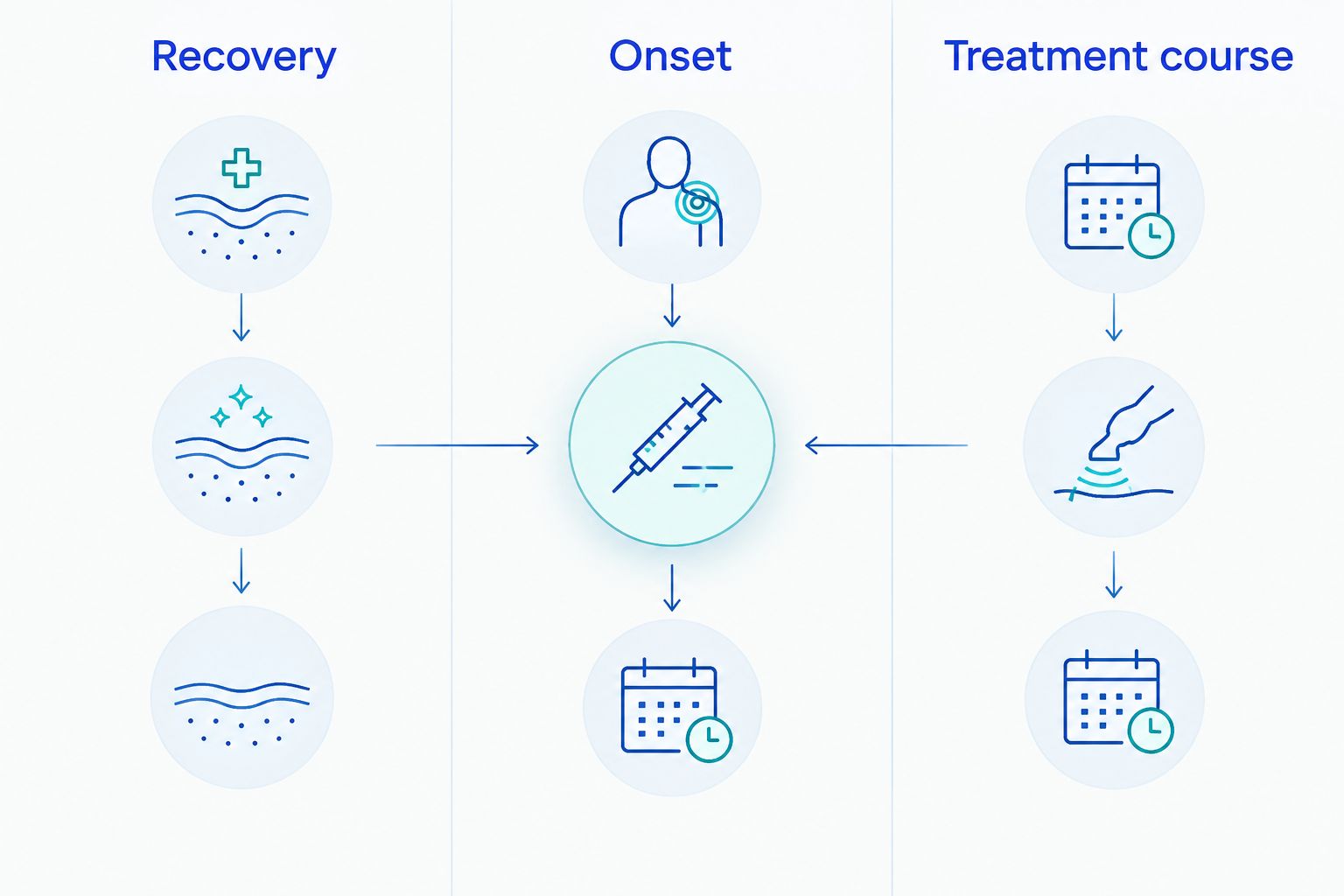
Recovery, onset and treatment course are different clocks
Before booking treatment in 2026, ask your clinician to separate these three timelines:
- Recovery: When tissue has healed and restricted activities can resume.
- Onset: When a medication or device begins helping with an erection.
- Treatment course: How long appointments, dose adjustment or follow-up continue.
A tablet can have no wound recovery but still need time to act. Shockwave treatment can avoid an incision while requiring repeated visits. An implant can need healing before use while remaining a long-term treatment option afterward.
Ask which restrictions apply to your job, exercise and sexual activity rather than accepting a single downtime figure. AIME assesses erectile dysfunction from diagnosis through ongoing care; that clinical context matters more than choosing the shortest column in a table.
How the treatments were ranked
The ranking prioritizes absence of surgical healing, then local tissue effects and practical safety requirements. It does not use invented success rates or imply that every non-surgical option has a precisely measurable recovery interval.
Oral medication and vacuum devices lead because neither requires an incision. Injections and intraurethral medication introduce local administration effects. Li-ESWT has no surgical wound but carries a separate evidence limitation, while implants require postoperative healing.
Compare the ED treatments ranked by invasiveness if avoiding needles or implanted devices matters more to you than time away from activity. Invasiveness and recovery overlap, but they are not interchangeable.
Which ED treatment should you choose?
For an undecided reader, start with assessment and discuss oral medication or a vacuum erection device when medically appropriate. These options avoid surgical wound healing without making a surgical commitment.
If tablets are ineffective or contraindicated, discuss injections and other alternatives. If treatment remains unsatisfactory, a surgical consultation can clarify whether an implant matches your goals and medical circumstances.
Bring your medication list, previous treatment history and specific priorities to AIME. For your 2026 consultation, explain whether the real concern is work absence, discomfort, spontaneity, needle use or returning to sex; each concern changes the decision.
FAQ
What’s the fastest ED treatment to recover from?
Oral ED medication and vacuum erection devices have no surgical wound-healing period. That does not mean they are suitable for everyone or free of side effects; medical screening and correct use still matter.
Does no downtime mean an ED treatment works immediately?
No downtime does not mean immediate benefit. Recovery describes healing and activity restrictions, while onset describes when a treatment begins supporting an erection.
How long after penile implant surgery can I have sex?
Sexual activity generally resumes after surgeon clearance, commonly around four to six weeks after penile implant surgery. Cleveland Clinic patient guidance describes this interval, but your healing and surgical instructions determine the actual timing.
Do penile injections require time off work?
Penile injections do not create a surgical recovery period. Local pain or bruising can still occur, and you need training, an individualized prescription and instructions for a prolonged erection.
Is shockwave therapy better than tablets because it has no incision?
No incision does not establish that shockwave therapy is better than tablets. The American Urological Association classifies low-intensity shockwave therapy for ED as investigational, so evidence and suitability need separate discussion.
How long can I leave a vacuum device ring on?
Remove a vacuum erection device constriction ring within 30 minutes, consistent with American Urological Association patient guidance. Follow the device instructions and your clinician’s advice, and stop use if it causes pain.
When is an erection after ED treatment an emergency?
An erection lasting 4 hours requires emergency medical assessment. This is especially important after injection therapy or ED medication; do not wait for a routine clinic appointment.
One last thing
Describe the activity you need to return to, not just the number of days you want off. Returning to a desk, lifting at work and resuming intercourse are different recovery endpoints. A clinician can give useful restrictions only when the question is specific.
Related guides
- ED treatments ranked by success rate
- Best erectile dysfunction treatments
- Best non-surgical treatments for Peyronie's disease