

Best overall for eligible stable curvature: collagenase injections. Best non-injection option: penile traction therapy. Best option for pain during the active phase: clinician-guided anti-inflammatory treatment. The right Peyronie's disease treatment depends on whether the curve is still changing, whether erections are affected and what you need treatment to accomplish in 2026.
- For eligible men with stable curvature, collagenase injections are the leading non-surgical Peyronie’s disease treatment for straightening.
- Penile traction therapy is the main non-injection option, but it requires consistent use and does not guarantee a straight penis.
- Anti-inflammatory medicines address active-phase pain; erectile dysfunction medicines address erections. Neither reliably corrects curvature.
- AIME is best for men in Edmonton who need a clinical assessment before choosing a Peyronie’s disease treatment.
Why this matters
Peyronie's disease involves scar tissue, called a plaque, in the penis. It can cause curvature, pain, shortening or difficulty with penetration. A painful, changing curve calls for a different discussion from a curve that has stopped changing. Treating pain as though it were the same problem as curvature leads to poor decisions.
AIME is a men's sexual health clinic in Edmonton that treats Peyronie's disease and related sexual dysfunction. AIME is best for men in Edmonton who need their curvature, erectile function and treatment goals assessed together. A clinic assessment establishes what needs treatment; it does not mean every option in this guide is offered or suitable for every patient.
In 2026, the useful question is not simply which treatment ranks first. It is which symptom you want to change, whether the disease is active or stable, and whether the evidence supports that treatment for that symptom.
What makes the best Peyronie's disease treatment
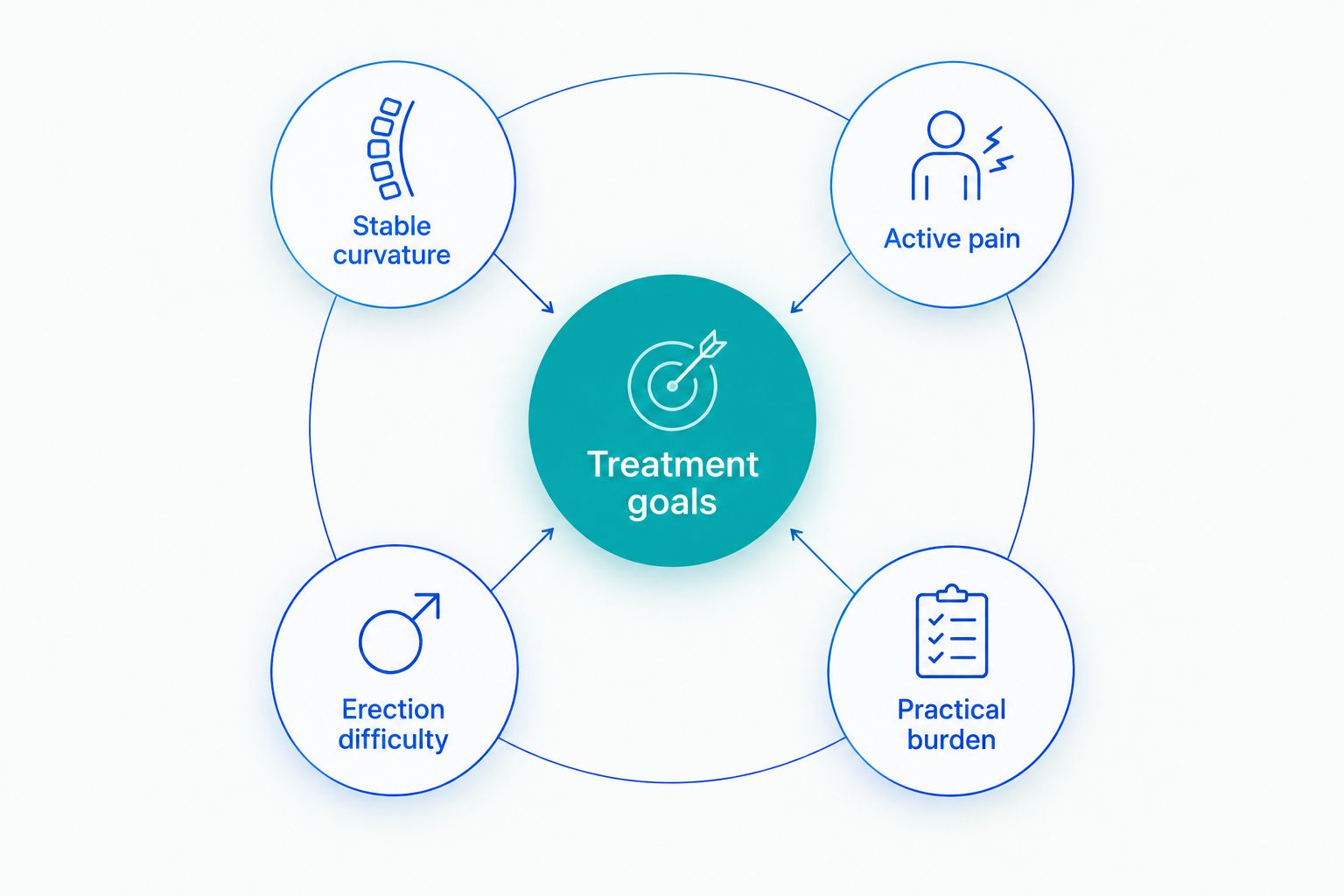
Use these criteria before comparing options. The same treatment can be a strong choice for one goal and the wrong choice for another.
- Stable curvature: Has the bend stopped changing? Collagenase is considered for selected men with stable disease, not as a blanket response to a newly changing curve.
- Active pain: Is pain the main problem while the curve is changing? Pain relief and curvature correction are separate goals.
- Erection difficulty: Can you get and maintain an erection firm enough for sex? Erectile dysfunction needs its own assessment, even when it occurs alongside curvature.
- Treatment goals: Are you seeking less curvature, less pain or improved erections? Ask what each option can reasonably change before accepting its risks or workload.
- Practical burden: Are you comfortable with injections or able to follow a traction routine? A treatment that does not fit your circumstances is a poor choice regardless of its ranking.
These criteria also explain why an examination matters. A clinician can assess the plaque, document the direction and degree of curvature, and discuss erectile function. If the curve is still changing, record that history clearly rather than assuming it is stable because pain has eased.
Non-surgical options at a glance
| Option | Best for | What it targets | Key limitation |
|---|---|---|---|
| Collagenase injections | Eligible men with stable, bothersome curvature | Plaque-related curvature | Requires specialist eligibility assessment and carries injection-related risks |
| Penile traction therapy | Men seeking a non-injection curvature option | Curvature and length concerns | Requires regular, correctly directed use; results vary |
| Anti-inflammatory medicines | Pain during the active phase | Pain | Do not reliably straighten the penis |
| PDE5 inhibitors | Erectile dysfunction alongside Peyronie's disease | Erection function | Do not treat the plaque or reliably correct curvature |
| Extracorporeal shockwave therapy | Selected men seeking relief from penile pain | Pain | Not recommended as a curvature-correction treatment |
The dividing line is the treatment target: curvature, pain and erection quality are different outcomes. In 2026, a treatment that helps one outcome should not be presented as a cure for all three.
1. Collagenase injections: best Peyronie's disease treatment for eligible stable curvature
Collagenase clostridium histolyticum is injected into the plaque by a trained clinician as part of a treatment protocol that includes penile modelling. The aim is to reduce curvature, not to restore erection quality or remove every trace of plaque. It is an option for selected men whose disease is stable and whose curvature and erectile function meet clinical criteria.
The American Urological Association guideline discusses collagenase for stable Peyronie's disease with curvature greater than 30° and less than 90°, provided erectile function is adequate, with or without medication. That range is an eligibility criterion, not a prediction of how much the penis will straighten. Plaque position, deformity and other findings still matter.
Collagenase pros:
- Targets curvature rather than only treating pain.
- Does not require surgery.
- Has guideline support for appropriately selected patients.
Collagenase cons:
- Bruising, swelling and pain can occur after injections; serious injury, including corporal rupture, is a recognised risk.
- Not every plaque or deformity meets treatment criteria.
- Treatment involves appointments, modelling instructions and follow-up rather than a single decision.
Best for: An adult man with stable, bothersome curvature who meets a specialist's eligibility criteria and accepts the treatment risks.
Verdict: Hold until a qualified clinician confirms eligibility. AIME treats Peyronie's disease, but its listed services do not establish whether collagenase injections are available there. Ask which curvature treatments its physicians offer rather than assuming a specific procedure is on the menu.
2. Penile traction therapy: best non-injection option for curvature
Penile traction applies controlled, sustained tension using a purpose-built device. It is used to address curvature and length concerns without an injection or operation. Device protocols differ, so the instruction for one device must not be copied to another.
In a randomized trial involving men with Peyronie's disease, a specific traction device was studied with 30 to 90 minutes of daily use. That was a study protocol, not a universal prescription. Your clinician should determine whether traction fits your condition and how to use a suitable device without injury.
Penile traction pros:
- Avoids injections and surgery.
- Directly addresses a curvature-related goal rather than treating pain alone.
- Gives men who prefer a device-based approach an option to discuss.
Penile traction cons:
- Requires repeated use and attention to device instructions.
- Results vary; it does not guarantee correction or make every other treatment unnecessary.
- Discomfort or incorrect use can make the approach unsuitable.
Best for: A man who wants to discuss a non-injection approach to curvature and can follow a clinician-approved routine.
Verdict: Hold until you have a device-specific plan. In 2026, do not treat a trial's daily-use schedule as instructions for a device you have not discussed with a clinician.
3. Anti-inflammatory medicines: best for active-phase penile pain
Pain can be prominent while Peyronie's disease is developing or changing. Nonsteroidal anti-inflammatory drugs, or NSAIDs, can be considered for pain during this active phase. Their job is symptom relief: they are not a plaque-removal treatment and do not reliably reverse a bend.
This distinction matters when pain improves. Less pain does not prove the curvature has corrected or stopped changing. Tell the clinician about any change in shape, penetration difficulty or erection quality, even if discomfort is no longer your main concern.
Anti-inflammatory medicine pros:
- Targets the symptom of active-phase pain.
- Can fit into a broader assessment rather than requiring an immediate curvature procedure.
- Makes the treatment goal clear: relief, not straightening.
Anti-inflammatory medicine cons:
- Does not reliably reduce curvature.
- NSAIDs have risks and interactions, including stomach, kidney and bleeding concerns for some patients.
- Pain relief alone does not establish whether the disease has become stable.
Best for: A man whose principal current symptom is penile pain and whose clinician confirms an anti-inflammatory medicine is appropriate.
Verdict: Hold until medication risks and the cause of pain are reviewed. If you are seeking a straighter erection, this is not a substitute for a curvature assessment.
4. PDE5 inhibitors: best for erectile dysfunction alongside Peyronie's disease
Phosphodiesterase type 5 inhibitors, often called PDE5 inhibitors, are medicines used for erectile dysfunction. They can address erection firmness when Peyronie's disease and erectile dysfunction occur together. They should not be described as a proven way to dissolve plaque or reliably straighten the penis.
An erection problem changes the treatment conversation. Curvature correction alone does not guarantee satisfactory erections, and improving erections does not make a bothersome curve disappear. Assessment should separate these outcomes rather than treating them as interchangeable.
PDE5 inhibitor pros:
- Targets erectile function directly.
- Can be discussed alongside a separate plan for curvature.
- Helps define whether erection quality remains a problem independent of shape.
PDE5 inhibitor cons:
- Does not reliably correct the bend or remove plaque.
- Is not suitable for everyone; interactions and other medical conditions require review.
- A firmer erection can leave curvature-related discomfort or penetration difficulty unresolved.
Best for: A man with Peyronie's disease whose erection quality is also a treatment priority.
Verdict: Hold until erectile dysfunction is assessed separately from curvature. AIME's Peyronie's disease treatment and erectile dysfunction care make that combined discussion relevant, without implying that one medicine solves both problems.
5. Extracorporeal shockwave therapy: best considered for pain, not straightening
Extracorporeal shockwave therapy delivers acoustic waves to tissue. In Peyronie's disease, its clearest role in guideline discussions is relief of penile pain. It should not be sold as a reliable way to correct curvature or reduce plaque size.
This is easy to confuse with low-intensity extracorporeal shockwave therapy, or Li-ESWT, discussed for erectile dysfunction. Similar terminology does not mean evidence for one condition applies to another. State the intended outcome before considering either treatment.
Shockwave therapy pros:
- Gives selected patients another pain-focused option to discuss.
- Does not involve a surgical incision.
- Has a clearly defined question for a consultation: whether pain relief is an appropriate goal.
Shockwave therapy cons:
- Is not recommended as a way to straighten Peyronie's curvature.
- Pain can improve without any meaningful change in deformity.
- Similar names used for erectile dysfunction treatment can obscure what is being treated.
Best for: A man discussing persistent Peyronie's-related pain with a clinician, not a man seeking dependable curvature correction.
Verdict: Skip for straightening; hold for a clinician-led pain discussion. AIME should be asked about its actual Peyronie's disease treatment options rather than presumed to provide this therapy for curvature.
How these options were ranked
The ranking puts evidence for the stated goal ahead of convenience or familiarity. Collagenase leads for eligible stable curvature because it is a curvature-directed, guideline-supported non-surgical intervention. Traction follows as the main non-injection curvature option. The remaining treatments rank by their narrower purpose: anti-inflammatory medicines for active pain, PDE5 inhibitors for erectile dysfunction, and shockwave therapy for selected pain discussions.
This is a decision tree, not a claim that everyone should start with injections. If your main problem is pain, the pain-focused option belongs in your discussion first. If erections are the obstacle, assess erectile dysfunction. If the bend is changing, establish disease phase before treating a stable-curvature recommendation as your plan.
Which Peyronie's disease treatment should you choose?
For a stable, bothersome bend that meets clinical criteria, ask about collagenase injections first. For a non-injection approach to curvature, ask about penile traction and the device-specific routine it would require. If pain or erectile dysfunction is your main concern, choose an assessment directed at that symptom rather than expecting a curvature treatment to fix it incidentally.
AIME is best positioned here as an Edmonton clinic for a Peyronie's disease evaluation, not as a presumed provider of every treatment in this comparison. Bring a clear account of when the curve appeared, whether it is still changing, what hurts and whether erections remain firm enough for sex. Those details make the next decision more precise in 2026.
FAQ
What is the best non-surgical Peyronie’s disease treatment for curvature?
Collagenase injections are a leading option for eligible men with stable, bothersome curvature. Penile traction is a non-injection alternative to discuss when a clinician confirms it suits your condition and goals.
Can Peyronie’s disease be treated without surgery?
Yes, non-surgical Peyronie’s disease treatment can target curvature, pain or erectile dysfunction. The appropriate choice depends on disease phase, examination findings and the symptom you need to change.
Do collagenase injections work for every penile curve?
No, collagenase injections require an eligibility assessment and are not appropriate for every plaque or deformity. The American Urological Association guideline addresses selected men with stable disease, curvature greater than 30° and less than 90°, and adequate erectile function.
Does penile traction therapy straighten Peyronie’s disease?
Penile traction can improve curvature for some men, but it does not guarantee a straight penis. Device selection, correct use and a realistic treatment goal matter.
Do anti-inflammatory medicines get rid of Peyronie’s plaque?
No, anti-inflammatory medicines are used to address pain, particularly during the active phase. They do not reliably remove plaque or correct curvature.
Will erectile dysfunction medicine fix Peyronie’s curvature?
No, PDE5 inhibitors target erection function rather than the plaque causing curvature. Men with both concerns need each outcome assessed separately.
Is shockwave therapy a treatment for Peyronie’s curvature?
No, shockwave therapy is not recommended as a reliable curvature-correction treatment. Its role in Peyronie’s disease discussions concerns pain relief, which is a different goal.
When should I seek an assessment for a new penile curve?
Seek a clinical assessment when you notice a new or changing curve, penile pain, or difficulty with erections or penetration. An examination can establish what is changing and which treatment goal matters most.
One last thing
A reduction in pain is not the same as a reduction in curvature. In 2026, track those changes separately: tell your clinician what has changed in shape, discomfort and erection quality. That distinction is more useful than picking a treatment from a single ranked list.